
Performance is the part of a campaign that has to survive contact with a spreadsheet. This page sets out how we plan it, what we make, what we measure, and what we will not promise.
What this service covers
Five things, run by one team rather than handed between vendors:
- Media planning and buying. Meta, Google, YouTube, TikTok and LinkedIn, planned against objectives rather than against a channel list.
- Search. Technical SEO, content built to rank, and the newer work of being the answer an AI assistant gives.
- Conversion tracking and analytics. Pixels, server-side events, tag hygiene, and the reporting that sits on top of them.
- Campaign mechanics. The things that turn attention into a registration, a follow, a lead or a sale.
- Reporting. A live dashboard from the first month, and a monthly report that carries its own caveats.
Media buying and planning should sit with the agency that built the creative. Ours does, and the measurement sits there too.
We start with your data, not our portfolio
Before we propose anything, we look at your brand the way buyers and machines actually find it. In the first weeks we will typically:
- Crawl the site the way a search engine does, reading the raw source rather than the rendered page.
- Read every ad you currently have running, and check where each one sends people.
- Run the questions your buyers search before they buy, and record whether you appear at all — and who is quoted instead of you.
- Read your owned channels and your competitors’ on the same day, so the comparison is fair.
- Check the category’s real seasonality against retail data, rather than assuming the obvious peak.
- Audit tracking end to end: pixels, server-side events, analytics containers, campaign tagging.
What comes out is a written baseline that both sides sign, and a list of findings with a fix and a date beside each one. We do not raise a problem we have not already costed a repair for.
Nothing is spent before the tracking works
The first phase is foundation, and it is a gate rather than a recommendation. No paid budget goes out before conversion tracking is verified. No article is published before the site can be crawled. Spend in the opening month is deliberately lighter than a straight line would suggest, because money spent before instrumentation is money that leaves no trace.
Where a fix depends on someone we do not control — a global platform team, an IT queue, a third-party CMS — it goes into the contract as a named dependency with a date, and we prepare a workaround we can run on our own in the meantime. We do not promise what we do not control, and we do not sit still waiting for it either.
Who you are actually talking to
A wide age range is not one audience. It is usually two, on different platforms, convinced by different evidence, and addressed in different language. We map that before the first brief is written, using penetration and panel data rather than habit, and we say which platform each cohort actually ranks first.
The output is not a slide of personas. It is a set of production rules: which form of address an asset uses, which formats each cohort responds to, which proof they need before they buy, and how the paid targeting is drawn so the edges of your audience are not cut off.
The plan
Every channel gets one job, and the job is argued from your objectives rather than from what is fashionable. Some channels are there for reach, some for engagement, some for search, and at least one is usually there for retention at almost no marginal cost. Content pillars are weighted the same way, and we will tell you which pillar we would spend more on and why.
The calendar follows the shopping calendar, not the head-office release calendar. Where a moment shows no real uplift in the data, we say so and put no media behind it. Being willing to name a month we will not spend in is worth more than adding another campaign to the deck.
What we make
Performance work fails more often on the asset than on the buy. What we produce:
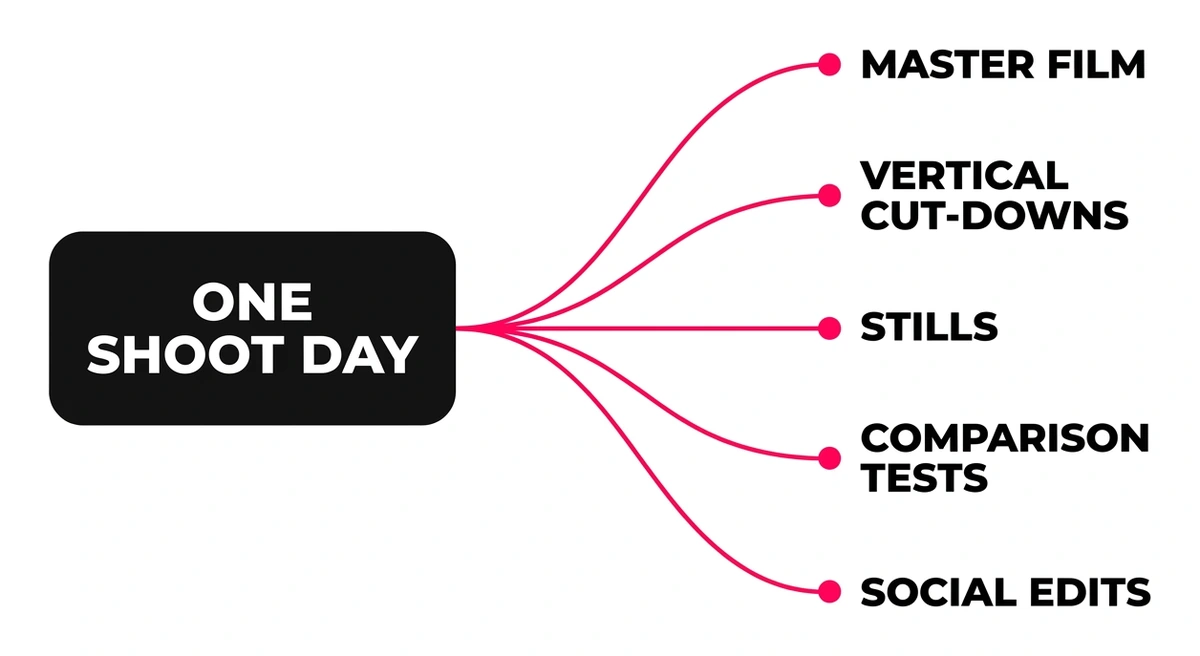
- Video. A master film with cut-downs for every placement, built from one shoot rather than one shoot per format. Short-form is built to read with the sound off, and long-form exists for the audience that genuinely watches it.
- Statics and carousels. Including the useful kind — comparison tables, sizing guides, things people save and send to someone else.
- Proof content. Side-by-side comparisons, durability and performance demonstrations, and testimonials from named real people rather than borrowed faces.
- Articles and landing pages. Written to answer a real question, with the structured data and internal linking that let both search engines and AI systems use them.
- Community and participation mechanics. User-generated content, quizzes and prize mechanics that produce an engagement and a mention at the same moment they produce a follower.
- Retail and offline-to-online. Partner and dealer kits, and QR mechanics that make the physical estate you already pay for measurable.
Local production is the default. Global assets are used as seasoning, never as the whole asset, and never in the opening seconds. Where we have measured it, locally made content in the local language outperforms translated global content by margins that are not close.
Search, and being the answer
Classic search still decides a large part of what you get for free. AI assistants increasingly decide the rest. We treat them as one job.
That means fixing the foundations first — crawl directives, rendering, canonicals, metadata, structured data — then publishing content in the formats that get quoted: a direct answer near the top, a table with real units, depth underneath, and questions answered in the words people actually use. Alongside it we build the entity itself, and we approach the sources that are already being cited in your category, because reaching them is cheaper than outranking them.
We measure it from a baseline captured before we start, on a fixed set of prompts, tested on the same schedule every month. What we commit to is measurable improvement and an honest cadence of reporting. Any agency that promises you a specific number of AI citations either does not understand the mechanism or is hoping that you do not.
Buying media that leaves something behind
The governing rule is that spend should build an asset rather than rent an impression. A tracking pixel, a retargeting audience, an indexed page and a first-party list all outlive the campaign that paid for them. An impression does not.
In practice that shapes the order of the buy. Engagement and view objectives run before follower objectives, because audiences built from people who already watched or interacted behave differently from audiences bought cold. Creative is used as a filter, so the people who arrive are the people who care. Search budget rises as video creates the demand for it, because buying brand clicks that do not yet exist is waste. And where we use paid to support engagement, we cap it, and we report organic and blended figures separately so you can always see which is which.
How we measure success
Most disputes about performance are really disputes about definitions. So we settle the definitions first, in writing.
Every KPI we sign has to pass four tests. It needs a baseline captured before the work starts, so there is an auditable zero point. It needs a denominator fixed in writing — which audience, which market, paid or organic. It has to be measurable rather than estimable. And it cannot be a promise about a system that is not deterministic.
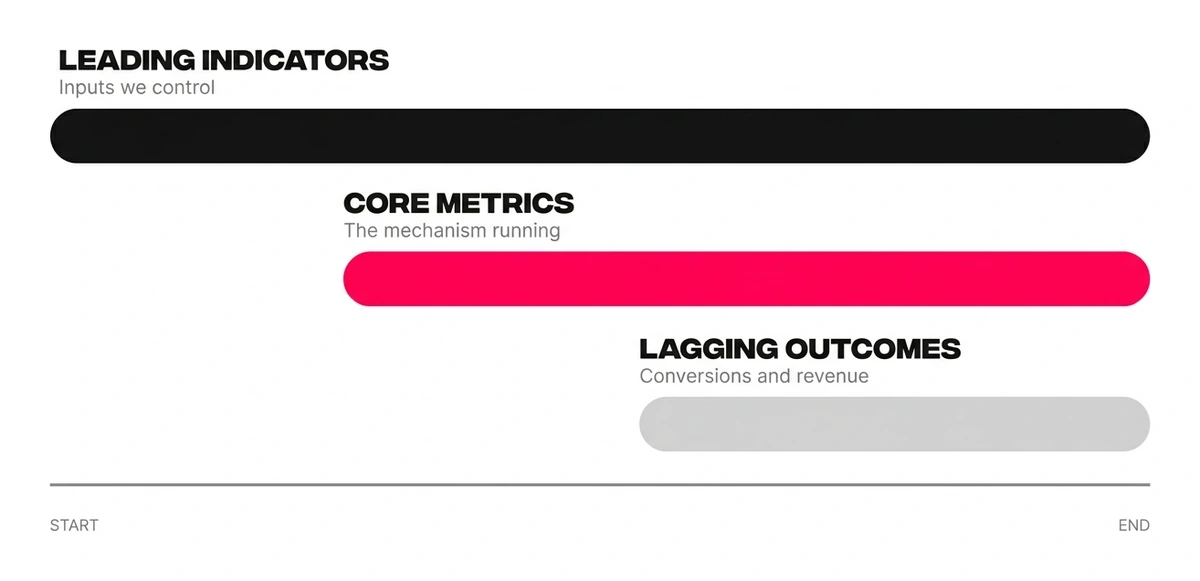
KPIs are then set in three tiers, so there is something real to judge us on from the first month rather than the sixth:
- Leading indicators, in the opening months. Inputs we fully control: implementation coverage, pages fixed, assets shipped, tracking verified.
- Core metrics, once the mechanism is running. Traffic quality, share of answer, engagement and view rates on defined denominators, cost per result.
- Lagging outcomes, once there is enough history to read them. Conversions, revenue-adjacent outcomes, and assisted contribution.
Targets are shaped to the category’s seasonality rather than divided evenly across twelve months, which means we will name our own weakest months before you sign rather than explain them in month five. Each KPI is also marked by ownership: ours, shared, or genuinely outside our control. Anything in the third group becomes a written carve-out with a named owner and a date, not a quiet promise.
What arrives every month
A live dashboard from the first month, and a monthly report with a fixed structure:
- What we own — results attributable to our work, with activity run by you or by other partners shown separately, and traffic that nobody can claim shown as exactly that.
- Committed against actual, on the agreed seasonal curve.
- Where the movement came from: how much was you improving, and how much was the competitive set moving.
- Root cause and action, on a fixed template that ends with a named owner and a date.
- Data quality and caveats, including what we could not measure cleanly this month.
- A production and brand-compliance audit, reported to you rather than kept internal.
What we will not promise
Some of this costs us claimed performance, which is rather the point.
Untagged traffic is claimed by nobody, including us. Where a session carries both our touchpoint and yours, we credit it to you. We report both a generous and a conservative attribution view and hold ourselves to the conservative one. We will not guarantee a ranking position or a citation count on systems whose output changes between two identical queries. And when a number improves because competitors fell rather than because you rose, we will tell you that, unprompted, in the month it happens.
How we work together
A retainer usually fails on approvals rather than on ideas, so the working agreement is explicit and it runs in both directions. Deliverables are approved in batches rather than asset by asset. Each type has a stated submission date, a review window and a fixed number of revision rounds. If we are late, the quota still stands. If a review window passes without feedback, the work is treated as approved — and if approvals slip repeatedly, that month’s quota adjusts and is recorded rather than quietly absorbed.
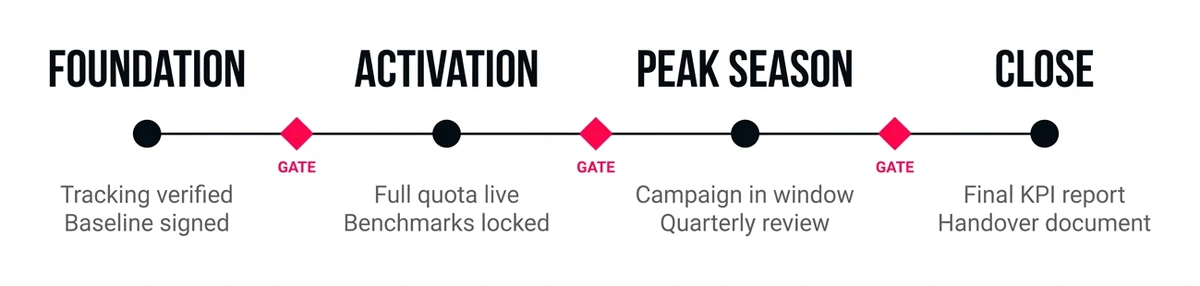
The engagement runs in phases with an exit gate on each: foundation, activation, peak season, and closing. Each gate is a measurable condition, not a date, and the last one includes a handover document you keep whatever happens next.
Common questions
Do you have to make the creative as well?
No, but it works better when we do. If your creative sits elsewhere, we will still take the media, search and measurement, and we will be direct with you about which results are constrained by assets we did not make.
How is it priced?
Bought per result, with the estimate per objective agreed before we start. Media, production and people are quoted separately so you can see what you are paying for.
How long before we see something?
Tracking and foundation work lands inside the first month, and you will have leading indicators to judge us on immediately. Paid results follow the buy. Search and answer-engine work is slower by nature: early movement in the first quarter, meaningful position later.
Can you work with the tracking and tools we already have?
Usually, yes. We audit what is there, fix what is broken, and only propose replacing something when the current setup cannot produce a number you can defend.
What if the fix needs our global or IT team?
It gets written down as a dependency with an owner and a date, and we carry a fallback we can run without them. That distinction is what separates a plan from a wish.
Do you do influencer and KOL work?
Yes, when the brief calls for it — search and outreach, including buzzer, celebgram and artist work. We will also tell you when your audience is the kind that does not respond to it.
Which markets do you cover?
Indonesia primarily, from Jakarta and Yogyakarta, with a Singapore presence for regional work.
Start a campaign
Tell us the objective and the constraint. We will tell you what it takes, what we would measure, and what we would not promise.
Or email sales@bigindigital.com.